

Amazon Associate Disclosure: This post contains affiliate links. As an Amazon Associate, I earn from qualifying purchases at no additional cost to you.
The original moka pot was invented in 1933 from aluminum — a material that made sense in an era before food-safety science had much to say about reactive metals in contact with hot, acidic liquids. Nine decades later, we know more. Aluminum can leach into food and beverages under heat and acidic conditions, and while the health risk from a single cup is small, daily use over years is a different conversation. For anyone who drinks moka pot coffee every morning — which is most moka pot owners — choosing a non-toxic alternative is a straightforward decision.
The good news is that stainless steel moka pots have improved dramatically. The five options on this list brew excellent coffee, work on every stovetop including induction, and eliminate the aluminum and plastic concerns entirely. Some go further — B Corp certification, oak wood handles instead of plastic, 25-year warranties, and verified social impact programs. This is a category where sustainability and quality genuinely align.
If you want to go deeper on non-toxic brewing across all formats, our full guide to non-toxic coffee makers for home use in 2026 covers everything from drip machines to pour over setups.
Why Stainless Steel Matters: The Health and Sustainability Case
Before getting to the picks, it is worth understanding what makes stainless steel moka pots meaningfully different from aluminum — not just as a marketing claim, but as a material choice with real implications for health and longevity.
Aluminum and acidity. Coffee is acidic, with a typical pH between 4.5 and 6.0. When hot, acidic liquid sits in contact with aluminum under pressure — exactly the conditions inside a moka pot during brewing — the metal can leach into the brew in small amounts. The quantities involved are low, but the concern is cumulative exposure over daily use across years. Health agencies have not declared aluminum moka pots unsafe, but the precautionary case for stainless steel is strong for daily drinkers.
Stainless steel is inert. Food-grade 18/8 or 304 stainless steel does not react with coffee acids under any normal brewing conditions. It imparts no metallic taste, does not corrode, and does not degrade over time. A quality stainless steel moka pot bought today should still be producing excellent coffee in 20 or 30 years — which is also the sustainability argument for buying one.
What to look for beyond the body. The material of the pot is the starting point, but a genuinely non-toxic moka pot also needs: a silicone gasket (not rubber, which can develop a chemical smell over time), no plastic components in the brew path, and a safety valve that is stainless steel rather than plastic. All five picks on this list meet these criteria.
Induction compatibility. Aluminum is not magnetic and does not work on induction stovetops. All five stainless steel options below are natively induction compatible — no adapter required. As induction becomes the standard in modern kitchens, this is increasingly a practical necessity rather than a nice-to-have.
Quick Comparison: Non-Toxic Stainless Steel Moka Pots
| Product | Material | Induction | Sustainability Standout |
|---|---|---|---|
| GROSCHE Milano Steel | 18/8 stainless steel | Yes | Certified B Corp, Safe Water Project |
| Cuisinox Roma | 18/10 stainless steel | Yes | 25-year warranty, no aluminum anywhere |
| Bialetti New Venus | 18/10 stainless steel | Yes | Italian heritage, dripless spout |
| Easyworkz Diego | 18/8 stainless steel | Yes | 24-month guarantee, wheat polymer gasket housing |
| WALDWERK Stainless Steel | 304 stainless steel | Yes | Solid oak wood handle, 100% plastic-free brew path |
1. GROSCHE Milano Steel — Best Overall for Sustainability
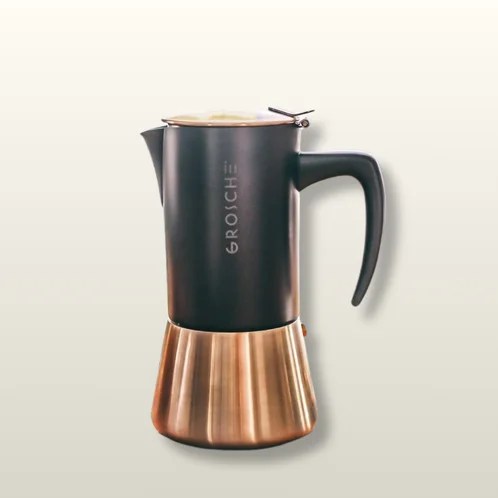
The GROSCHE Milano Steel is the standout sustainability pick on this list — and it earns that position through verified credentials, not marketing claims. GROSCHE is a Certified B Corporation: a third-party certification that evaluates a company’s social and environmental performance across its entire supply chain, employment practices, and operations. It is one of the most rigorous sustainability certifications available to a consumer goods brand, and GROSCHE holds it alongside being carbon-neutral and a Living Wage Employer.
Every GROSCHE purchase also funds 50+ days of safe drinking water through the GROSCHE Safe Water Project, which has installed over 2,800 Biosand filters and funded more than 300 million days of clean water access across six countries. This is not a token donation program — it is the core commercial purpose of a company founded in 2006 as a social enterprise.
On material credentials, the Milano Steel is built entirely from food-safe 18/8 stainless steel with a non-toxic silicone gasket and a certified Italian safety valve. It works natively on all stovetops including induction, brews 6 cups (9.3 fl oz) in under five minutes, and is dishwasher safe. With over 20,000 reviews and a 4.5-star rating, it is the #1 moka pot collection in North America — a product that has earned its reputation through consistent performance over years of daily use.
Sustainability credentials: Certified B Corporation • Carbon-neutral • Living Wage Employer • Safe Water Project (300M+ days of clean water funded) • 18/8 stainless steel throughout • Non-toxic silicone gasket • Fully repairable • No disposable components
Key Specs
- Material: 18/8 food-safe stainless steel
- Sizes: 6-cup (9.3 oz) and 10-cup
- Stovetop: Gas, electric, glass, induction, propane, campfire
- Gasket: Non-toxic silicone
- Dishwasher safe: Yes
- Warranty: Standard
Who This Is For
- Buyers who want the strongest verified sustainability story in the category
- Induction cooktop users wanting native compatibility
- Anyone who wants their purchase to fund measurable social impact
2. Cuisinox Roma — Best for Non-Toxic Purity
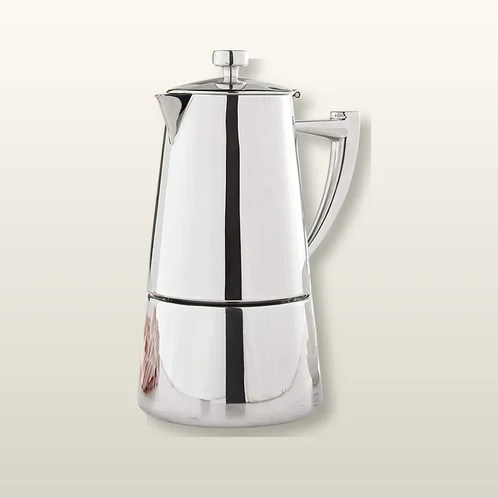
The Cuisinox Roma is the purist’s choice on this list. Built from 18/10 stainless steel — the highest grade used in premium cookware — the Roma has no aluminum anywhere in its construction and no plastic in the brew path. Every component that touches water or coffee is stainless steel or food-safe silicone. For buyers whose primary concern is eliminating reactive materials from their daily brew entirely, this is the most uncompromising option available.
The 18/10 designation means the steel contains 10% nickel alongside 18% chromium, giving it superior corrosion resistance and a brilliant mirror polish that holds up through years of daily use. It brews a clean, flavour-true cup with excellent body — the stainless brew path lets the beans express themselves without any interference from the pot material.
The Roma’s standout practical credential is its 25-year warranty — a remarkable commitment that reflects genuine confidence in the product’s durability. From a sustainability standpoint, a 25-year warranty is one of the most meaningful signals a brand can send: this pot is designed to last decades, not to be replaced. It is dishwasher safe, induction compatible, and available in multiple sizes. The price-to-longevity ratio is exceptional for a pot backed by a 25-year warranty.
Sustainability credentials: 18/10 stainless steel • No aluminum anywhere • No plastic in brew path • 25-year warranty • Induction compatible • Dishwasher safe • Fully repairable
Key Specs
- Material: 18/10 stainless steel (highest grade)
- Stovetop: All types including induction
- Gasket: Food-safe silicone
- Dishwasher safe: Yes
- Warranty: 25 years
- Rating: 4.4/5, Amazon’s Choice
Who This Is For
- Health-conscious buyers who want zero reactive materials in the brew path
- Anyone who wants a premium lifetime moka pot backed by a 25-year warranty
- Those who prioritise the highest grade stainless steel available
3. Bialetti New Venus Induction — Best Heritage Stainless Steel Option
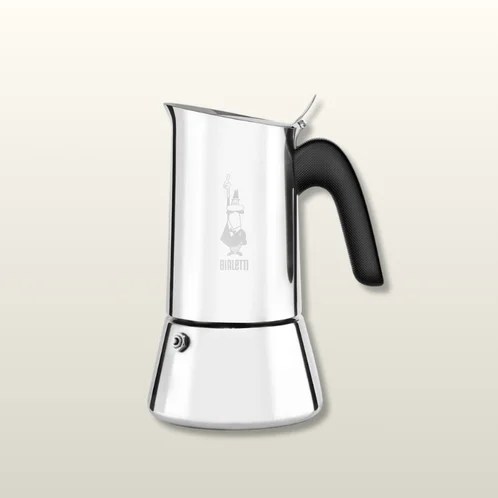
Bialetti invented the moka pot in 1933 and has been refining it ever since. The New Venus Induction is the brand’s answer to two modern demands: stainless steel construction and induction compatibility. While the iconic Moka Express remains aluminum — and remains the world’s best-selling moka pot on conversion volume alone — the New Venus brings Bialetti’s brewing heritage into a non-toxic, induction-ready format without losing what makes the original great.
The New Venus is built from 18/10 stainless steel throughout, with Bialetti’s patented safety valve and a heat-resistant insulated handle designed to stay cool during brewing. The dripless spout is a practical refinement that the original Moka Express lacks — it pours cleanly without drips or dribbles, which matters for daily use. It is the most accessible 18/10 stainless option on this list.
From a sustainability standpoint, the New Venus is built to last. The 18/10 stainless steel resists corrosion and maintains its finish through years of daily use. Replacement gaskets are available directly from Bialetti, extending the pot’s life indefinitely. The brand’s Italian manufacturing heritage and century of refinement in moka pot design mean that the underlying engineering is as mature as it gets.
Sustainability credentials: 18/10 stainless steel • No aluminum in brew path • Induction compatible • Replacement parts available • Fully repairable • No disposable components
Key Specs
- Material: 18/10 stainless steel
- Stovetop: All types including induction
- Handle: Heat-resistant insulated
- Spout: Dripless design
- Safety valve: Bialetti patented
- Rating: 4.5/5, 4,200+ reviews
Who This Is For
- Bialetti fans who want to upgrade from aluminum to stainless steel
- Induction cooktop users who want a trusted Italian brand
- Anyone who values heritage design and a century of moka pot refinement
4. Easyworkz Diego — Best Value Non-Toxic Option
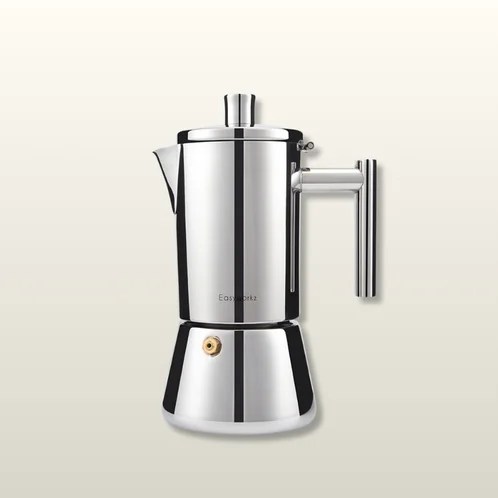
The Easyworkz Diego is the value proposition on this list — an 18/8 stainless steel moka pot with full induction compatibility, a non-toxic silicone gasket, and a mirror-polish finish at the lowest price point of the five. For buyers who want to move away from aluminum without paying a premium, the Diego delivers the essential non-toxic credentials at an accessible price.
The Diego is built entirely from food-safe 18/8 stainless steel with high mirror polishing that resists rust and corrosion effectively. The hollow insulated lid and cool-touch handle make for safe, comfortable handling even straight off the stove. It brews 4 full cups (6.8 fl oz) and includes a coffee reducer for smaller servings, plus a built-in certified safety valve. The 24-month quality guarantee from Easyworkz provides reasonable coverage for a product at this price point.
On sustainability, the Diego’s strongest argument is durability and repairability. The all-stainless construction means no aluminium corrosion, no plastic degradation, and no material concerns over years of use. It disassembles fully for cleaning and maintenance, and the simple construction means there is very little that can go wrong mechanically.
Sustainability credentials: 18/8 stainless steel • Non-toxic silicone gasket • Induction compatible • No plastic in brew path • Dishwasher safe • 24-month guarantee
Key Specs
- Material: 18/8 stainless steel, mirror polished
- Capacity: 4-cup (6.8 fl oz / 200ml)
- Stovetop: Gas, electric, ceramic, induction
- Gasket: Non-toxic silicone
- Includes: Coffee reducer for smaller brews
- Dishwasher safe: Yes
Who This Is For
- Budget-conscious buyers who want stainless steel without overspending
- Solo brewers who prefer a 4-cup size for daily single-serve use
- Induction users looking for the most affordable compatible option
5. WALDWERK Stainless Steel Moka Pot — Best for Plastic-Free Brewing
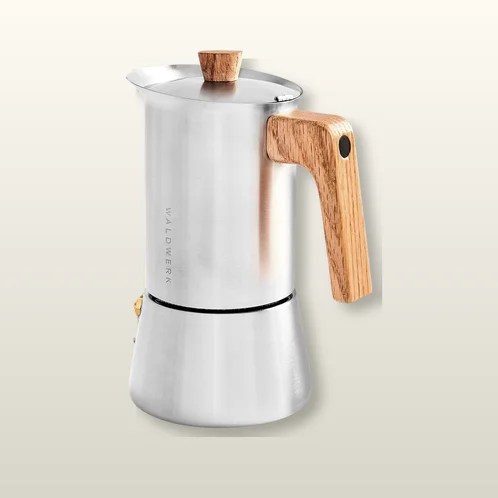
The WALDWERK is the most explicitly health-focused moka pot on this list — the brand markets it as “100% toxic free” and backs that claim with 304 stainless steel construction and, most distinctively, a solid oak wood handle instead of plastic. Where every other moka pot on this list uses some form of heat-resistant plastic or composite handle, the WALDWERK replaces it with natural oak. It is a small but meaningful material choice that eliminates the last plastic component from the brew and handling experience.
304 stainless steel is the same grade used in surgical equipment and food processing facilities — it is marginally more corrosion-resistant than 18/8 (which is functionally equivalent to 304) and gives the WALDWERK a genuinely premium feel in hand. The pot is induction compatible, works on all stovetop types, and includes a stainless steel safety valve. The oak handle stays cool during brewing and develops a natural patina over time that makes each pot subtly unique with use.
The WALDWERK is packaged in a magnetic gift box with an upgraded metal hinge for durability — details that reflect a brand thinking carefully about the full product experience. It backs its build quality with a money-back guarantee. For buyers who want the most complete plastic-free stovetop espresso setup available at this price, the WALDWERK is a compelling and distinctive choice.
Sustainability credentials: 304 stainless steel • Solid oak wood handle (no plastic) • 100% plastic-free brew path • Induction compatible • Stainless safety valve • Money-back guarantee
Key Specs
- Material: 304 stainless steel throughout
- Handle: Solid oak wood — no plastic
- Capacity: 10 oz (6 cup)
- Stovetop: Induction, gas, ceramic, electric
- Safety valve: Stainless steel
- Packaging: Magnetic gift box
Who This Is For
- Health-conscious buyers who want to eliminate plastic entirely from the brew and handling experience
- Those who value natural materials and premium craftsmanship at a mid-range price
- Anyone who wants a distinctive, beautifully designed moka pot as a daily ritual object
Sustainability Matters: Buy Once, Buy Right
Every moka pot on this list shares a foundational sustainability characteristic: it produces zero waste per cup. No pods, no capsules, no paper filters, no foil packaging. Just ground coffee and hot water, brewed in a reusable vessel that will outlast almost any other coffee maker you own. In a world where billions of coffee capsules end up in landfill every year, a stainless steel moka pot is one of the cleanest brewing choices you can make.
Longevity is the sustainability multiplier. A stainless steel moka pot bought today, maintained properly, can still be in daily use in 2050. The Cuisinox Roma backs this with a 25-year warranty. The GROSCHE Milano Steel is used by people who have owned theirs for a decade without issues. When you divide the environmental cost of manufacturing a stainless steel moka pot across 20 years of daily use, the footprint per cup is negligible.
Repairability extends life further. All five moka pots on this list are fully repairable. The only component that typically needs replacing over years of use is the gasket seal — available for a few dollars from each brand. This is how durable goods should be designed: not sealed, not proprietary, not requiring a full replacement when one small part wears out.
No electricity. Every moka pot here is a manual brewer. No heating elements, no pumps, no circuit boards. Over years of daily use, the zero electricity draw of a stovetop brewer is meaningfully more sustainable than any electric coffee maker, particularly in regions where the grid is fossil-fuel heavy.
The GROSCHE difference. Of the five, only GROSCHE has third-party verified sustainability credentials through B Corp certification. Buying a GROSCHE Milano Steel is the only option on this list where your purchase directly funds a specific, measurable environmental and social good — clean water access for communities in need. For buyers who want their coffee purchase to do something beyond brew a good cup, that distinction is worth noting.
For a broader look at sustainable stovetop espresso options including portable and manual lever brewers, our guide to the best portable espresso makers for travel in 2026 covers zero-electricity options across every format and budget.
Common Mistakes to Avoid
1. Buying stainless steel and then using harsh cleaning products. One of the key advantages of stainless steel is that it cleans perfectly with warm water and a soft brush — no detergents required. Harsh abrasive cleaners or scouring pads can scratch the polished surface and create micro-abrasions where coffee oils accumulate. Rinse with warm water after each brew and air dry thoroughly.
2. Ignoring the gasket. The gasket is the one component in a moka pot that does wear over time. A worn gasket allows steam to escape rather than drive water through the coffee, resulting in weak, under-extracted brews. Check the gasket every few months — if it looks cracked, flattened, or smells off, replace it. Replacement gaskets cost a few dollars and are available for all five pots on this list.
3. Leaving water in the pot between brews. Even stainless steel can develop mineral deposits if water sits in the chamber for extended periods, particularly in hard water areas. Empty the pot fully after each brew, separate the chambers, and leave them to air dry. This takes 30 seconds and keeps the pot performing perfectly for years.
4. Using too fine a grind. Moka pot grind should be medium-fine — finer than filter coffee but coarser than espresso. Using an espresso-fine grind in a moka pot over-restricts water flow, creates excessive pressure, and can damage the safety valve over time. A quality burr grinder set to the right range makes a significant difference. Our guide to the best coffee grinders under $250 for home espresso in 2026 covers the best options.
5. Assuming all stainless steel moka pots are equal. The grade of steel matters. 18/10 (used in the Cuisinox Roma and Bialetti New Venus) is more corrosion-resistant than standard 18/8. 304 surgical-grade steel (WALDWERK) is comparable to 18/10. These are meaningful differences for longevity, not just marketing language.
Frequently Asked Questions
Is aluminum really a health concern in moka pots?
The health authorities have not declared aluminum moka pots dangerous, and the quantities that leach into a single cup are small. However, coffee is acidic and brewing happens under heat and pressure — conditions that accelerate metal leaching. For daily drinkers over years, the cumulative exposure argument for switching to stainless steel is reasonable. Stainless steel is completely inert under these conditions, so the switch eliminates the question entirely without any trade-off in brewing quality.
What is the difference between 18/8, 18/10, and 304 stainless steel?
The numbers refer to chromium and nickel content. 18/8 steel contains 18% chromium and 8% nickel — food-safe, corrosion-resistant, and used in most quality kitchen equipment. 18/10 contains 10% nickel, giving it slightly better corrosion resistance and a brighter finish. 304 is a standard designation that is functionally equivalent to 18/8. All three are completely safe for daily coffee brewing and will not leach into your coffee under normal conditions.
Do I need a special grinder for a moka pot?
A burr grinder set to medium-fine will produce significantly better results than pre-ground coffee. The consistency of grind size matters for even extraction — blade grinders produce uneven particles that lead to mixed extraction. That said, most moka pots with pressurised baskets (including all five on this list) are reasonably forgiving with pre-ground coffee if you don’t have a grinder yet. Starting with a quality medium grind from a specialty roaster is a reasonable entry point.
Are all these moka pots truly induction compatible?
Yes — all five are natively induction compatible without an adapter. This is one of the key practical advantages of stainless steel over aluminum. The magnetic stainless steel base conducts the induction field directly, providing even, efficient heating. If you are on an induction cooktop, use a medium power setting and reduce slightly once the coffee begins to flow.
How often should I replace the gasket?
For daily use, most gaskets last one to two years before showing wear. Signs that it is time to replace include visible cracking or flattening of the silicone, steam escaping from the join between the chambers during brewing, or a chemical smell from the gasket. Replacement gaskets are available for all five pots on this list, typically for under $5. Replacing the gasket is a two-minute job that extends the pot’s life by years.
Which of these is best if I am switching from an aluminum Bialetti?
The Bialetti New Venus Induction is the natural upgrade — same brand, same brewing logic, same iconic design language, but in 18/10 stainless steel with native induction compatibility. The transition requires zero learning curve since the brewing method is identical. If you want a stronger sustainability story beyond the material upgrade, the GROSCHE Milano Steel is the next step up with its B Corp credentials and Safe Water Project.
A Note for the Holiday Season: These Make Excellent Gifts
Stainless steel moka pots sit in a gift sweet spot that’s hard to beat — the price point feels considered without being extravagant, and a beautiful stovetop brewer is something a coffee lover will reach for every morning for the next decade. It’s a purchase that keeps giving long after the holidays are over.
A few gift-specific notes worth knowing: the WALDWERK arrives in a magnetic gift box with a metal hinge, so it’s gift-ready with no extra wrapping needed. The GROSCHE Milano Steel has the most meaningful gift story — every purchase funds 50+ days of clean water through the Safe Water Project, something worth sharing with the recipient. The Cuisinox Roma’s 25-year warranty makes it the gift that signals permanence. And for anyone upgrading from a classic aluminum Bialetti, the New Venus Induction is a natural, no-learning-curve step up.
For a complete coffee gift set, any of these pairs well with a bag of specialty beans from a local roaster and a quality burr grinder — our guide to the best coffee grinders under $250 for home espresso in 2026 covers the best options at every budget.
Final Verdict
All five moka pots on this list address the core health and sustainability concern — aluminum in the brew path — with stainless steel construction, food-safe silicone gaskets, and induction compatibility. The differences between them come down to priorities.
For the strongest verified sustainability story: GROSCHE Milano Steel — B Corp certified, carbon-neutral, Safe Water Project.
For the most non-toxic brew path and best warranty: Cuisinox Roma — 18/10 stainless, no aluminum anywhere, 25-year warranty.
For heritage Italian design in stainless steel: Bialetti New Venus — 18/10 stainless, dripless spout, trusted brand.
For the best value non-toxic option: Easyworkz Diego — 18/8 stainless, induction compatible, most affordable on the list.
For the most plastic-free brewing experience: WALDWERK — 304 stainless, solid oak handle, zero plastic anywhere.
Looking for a grinder to pair with any of these? Our roundup of best coffee grinders under $250 for home espresso in 2026 covers the best options at every budget.
Looking for More Sustainable Coffee Products?
Visit sustainablecoffeeproducts.ca for more reviews, comparisons, and guides to building a home coffee setup that’s built to last.


Leave a Reply