
Amazon Associate Disclosure: This post contains affiliate links. As an Amazon Associate, I earn from qualifying purchases at no additional cost to you.
If you’ve been searching for a serious home espresso machine that won’t drain your savings or compromise on quality, the Gaggia Classic Evo Pro (RI9380/46 E24) keeps coming up — and for good reason. Priced around $450, it’s one of the few machines under $500 that ships with genuinely commercial-grade components: a 58mm stainless steel portafilter, a lead-free brass boiler, and a 9-bar OPV factory set correctly right out of the box.
From a sustainability standpoint, the Gaggia Classic Evo Pro represents exactly the kind of buy-once, buy-right philosophy we champion here. It’s built in Italy from metal components designed to last decades — and with an active community of home baristas who mod and repair these machines, this isn’t an appliance you’ll discard in three years. It’s one you’ll hand down.
In this review, we’ll walk through everything you need to know: real-world performance, build quality, who it’s best suited for, and where it falls short. Whether you’re weighing it against other machines in this price range or deciding if home espresso is even worth the leap — we’ve got you covered.
We’ve already covered strong options in our roundup of espresso machines under $500 for home use in 2026. This post goes deeper on one standout worth your serious attention.
Gaggia Classic Evo Pro: Quick Specs at a Glance
| Specification | Details |
|---|---|
| Model | RI9380/46 E24 |
| Price | ~$450 USD |
| Portafilter | 58mm stainless steel commercial |
| Boiler | Lead-free brass, 1425W |
| Brew Pressure | 9-bar OPV (factory set) |
| Solenoid Valve | 3-way commercial |
| Steam Wand | Commercial, 2-hole tip |
| Water Tank | 2.1L removable |
| Weight | 20 lbs |
| Origin | Made in Italy |
| Controls | 3 rocker switches (power, brew, steam) |
| Included Baskets | 7g single, 14g double, 14g pressurized |
Prices are in US dollars and may vary.
Build Quality and Design: What 35 Years of Refinement Looks Like
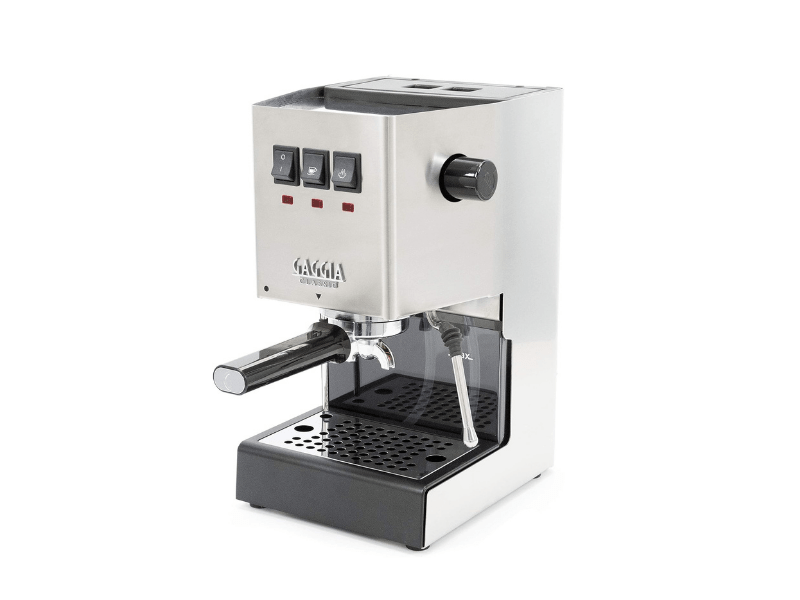
The Gaggia Classic line has been in continuous production since 1991 — and the E24 generation is arguably its most refined iteration to date. What you get in the box is a machine that feels genuinely substantive. At 20 pounds, it carries the satisfying heft of professional equipment, and the brushed stainless steel housing isn’t just cosmetic: it resists rust, fingerprints, and the daily wear of a busy kitchen in ways that plastic-bodied machines simply don’t.
The three rocker switches — power, brewing, and steaming — are unapologetically old-school. There’s no touchscreen, no app, no programmable volume dosing. What you get instead is direct, tactile control that puts you fully in charge of the process. Each switch has its own indicator light, so you always know whether the machine is heating to brew temperature or transitioning to steam.
The E24 designation marks a significant internal upgrade from earlier Evo Pro models: a solid, lead-free brass boiler replacing the aluminium boiler used in previous versions. This matters for two practical reasons. Brass offers superior thermal mass and temperature stability compared to aluminium, which translates to more consistent shot-to-shot extraction. And the lead-free designation eliminates any concern about heavy metals in the water path — a meaningful point for health-conscious buyers. The E24’s brass boiler also has roughly 30% more capacity than the old aluminium boiler, which helps with both brewing consistency and the transition to steaming milk.
Updated pump mounting in the Evo Pro generation reduces vibration noise compared to earlier Classic Pro models — a quality-of-life improvement that makes daily use noticeably more pleasant. The machine still won’t win awards for silence, but it’s a meaningful step forward from the earlier generation’s rattle.
One area that hasn’t changed is the steam wand. It’s a commercial-style two-hole tip wand, fully capable of producing proper microfoam for latte art — but it requires real technique. If you’ve used a superautomatic machine with an automatic frother, expect a learning curve. That’s not a flaw; it’s part of what makes this machine so rewarding to grow with.
Espresso Performance: Does the Factory 9-Bar OPV Actually Matter?
This is where the Gaggia Classic Evo Pro earns its reputation. Earlier versions of the Classic Pro shipped from the factory with an overpressure valve (OPV) set at 12 bars — significantly above the 9-bar standard recommended by the Specialty Coffee Association for proper espresso extraction. Correcting this required an aftermarket OPV swap that voided the manufacturer warranty, a common frustration for new owners.
With the Evo Pro, Gaggia addressed this directly. North American units ship with a factory-set 9-bar OPV right out of the box — no modification needed, no warranty voided. The practical result is cleaner extraction with less risk of channeling, better flavor clarity, and more forgiving shot windows. If you’ve ever pulled a bitter, hollow espresso from an over-pressured machine, you’ll notice the difference immediately.
The 58mm commercial portafilter amplifies this advantage. It’s the same size used in professional café equipment — a wider puck surface means more even water distribution and better extraction efficiency. Paired with quality freshly ground beans, the results are genuinely excellent: rich crema, balanced acidity, and a full-bodied shot that makes skipping the coffee shop feel like a reasonable life choice.
The three-way solenoid valve deserves explicit mention. After your shot pulls, this valve releases pressure from the group head, leaving a dry, compact puck that knocks out cleanly. Beyond convenience, it also protects your portafilter baskets and keeps the group head cleaner between sessions — a small but meaningful contribution to the machine’s long service life.
One area of honest limitation: the Evo Pro does not have a PID temperature controller. You’re relying on a thermostat-controlled single boiler, which means shot-to-shot temperature variation is possible. Experienced home baristas use a technique called temperature surfing — timing their pull relative to the boiler’s heating cycle to catch it at optimal brew temperature. It’s learnable with practice, but it does represent the gap between the Gaggia and higher-end prosumer machines with proper PID control.
For context on how the Gaggia compares to integrated grinder-machine combos, our Breville Barista Express review explores a popular alternative, and our Breville Barista Express vs Bambino Plus comparison digs into what you gain and give up at similar price points.
Who the Gaggia Classic Evo Pro Is Best For
The Gaggia Classic Evo Pro hits a very specific sweet spot. It’s not the right machine for everyone — but for the right buyer, it’s an exceptional value that’s hard to beat anywhere near this price range.
It’s a strong fit if you:
- Want commercial-grade components without a commercial price tag
- Are willing to invest time learning espresso fundamentals — grind size, dose, tamp, and shot timing
- Value long-term durability over short-term convenience features
- Plan to pair it with a quality burr grinder (essential for the non-pressurized baskets)
- Care about repairability — the Gaggia Classic has one of the most active and well-documented home repair communities of any espresso machine
- Want to avoid the ongoing cost and waste of pod-based machines
It may not be the right choice if you:
- Want great espresso with minimal learning curve — a superautomatic or a machine with integrated PID will serve you better
- Are brand new to espresso and don’t yet have a grinder — budget for both together, or you won’t get the best from this machine
- Primarily want automatic milk frothing — the steam wand here requires manual technique and practice
Sustainability Matters: Buy Once, Buy Right
At sustainablecoffeeproducts.ca, our core belief is simple: the most sustainable purchase is the one you only have to make once. The Gaggia Classic Evo Pro is one of the clearest expressions of that principle in the home espresso category.
Built to last — literally decades. The original Gaggia Classic launched in 1991 and has been in continuous production ever since. Many home baristas are still pulling shots on machines from the early 2000s. The all-metal housing, commercial-grade internals, and straightforward electrical design mean there’s very little to fail catastrophically. When something does eventually wear — a seal, a gasket, a solenoid valve — replacement parts are inexpensive and widely available. You fix it and keep going.
Repairability is a sustainability feature. Unlike many modern appliances designed to be replaced rather than repaired, the Gaggia Classic has one of the most well-documented repair ecosystems in the home espresso world. Detailed video teardowns exist for virtually every maintenance task. Parts suppliers stock everything from group head gaskets to boiler components. This keeps your machine out of the landfill for far longer than the typical consumer appliance lifecycle — and that matters.
Lead-free brass boiler. The E24 generation’s most significant upgrade is also its most meaningful from a health and environmental perspective. The lead-free brass boiler eliminates any concern about heavy metals in your water path, and brass is a fully recyclable material should the machine eventually reach end of life. No coatings, no plastics, no compromises in the water circuit.
Energy efficiency in real-world use. The 1425W boiler heats to brew temperature in roughly 5 minutes and doesn’t maintain a second boiler circuit at temperature while idle. For daily home use, this single-boiler design uses meaningfully less energy than dual-boiler machines that keep two heating circuits hot simultaneously — an advantage that compounds over years of use.
Zero capsule waste. Every shot pulled on the Gaggia uses fresh ground coffee and a reusable portafilter basket. No pods, no capsules, no foil packaging going to landfill with every cup. Over a year of daily use, that’s a significant reduction in single-use waste compared to pod-based machines — a difference that adds up fast.
If you’re thinking more broadly about building a non-toxic, sustainable home coffee setup, our guide to non-toxic coffee makers for home use in 2026 explores these themes across a wider range of brewing styles and budgets.
Common Mistakes to Avoid with the Gaggia Classic Evo Pro
After studying the owner community extensively, a consistent set of mistakes comes up among new Gaggia Classic owners. Avoiding these will dramatically shorten your learning curve and improve your results from day one.
1. Pairing it with an inadequate grinder. The non-pressurized baskets demand freshly ground coffee at a fine, consistent grind. A blade grinder or entry-level burr grinder won’t deliver the particle consistency needed for clean extraction — you’ll get channeling, sour or bitter shots, and a frustrating experience. Budget at least $100–$150 for a grinder alongside this machine. Many experienced home baristas ultimately spend as much on their grinder as the machine itself.
2. Skipping the group head flush. Single-boiler machines transition between brew and steam temperatures, which means the group head can be at the wrong temperature when you’re ready to pull. A brief flush — running a small amount of water through the head before locking in the portafilter — stabilizes temperature and measurably improves shot-to-shot consistency. Make it part of your ritual.
3. Over-relying on the pressurized basket. The included pressurized basket is forgiving with pre-ground coffee and coarser grinds, and it will produce a decent-looking crema. But the flavor won’t match what the non-pressurized double basket delivers with freshly ground beans. Use the pressurized basket as a starting point while you get your grinder dialed in, then move to the double non-pressurized basket and don’t look back.
4. Neglecting descaling. Hard water accelerates scale buildup in any espresso machine. The brass boiler in the E24 is more corrosion-resistant than aluminium, but scale accumulation still affects performance and longevity over time. Establish a descaling routine based on your local water hardness — typically every 2–3 months in moderate-hardness areas.
5. Forgetting to backflush. The three-way solenoid valve makes the Gaggia backflushable — a genuine maintenance advantage that many entry-level machines lack. Regular backflushing with an appropriate espresso machine cleaner removes coffee oil buildup from the group head and keeps your machine extracting cleanly. Add it to your weekly routine.
Frequently Asked Questions
Is the Gaggia Classic Evo Pro good for beginners?
It can be a great beginner machine, but it comes with a genuine learning curve. Unlike superautomatic machines that handle grinding, dosing, and extraction automatically, the Gaggia requires you to understand and control grind size, dose, tamp pressure, and shot timing. If you’re willing to invest time learning — and there’s an enormous, welcoming online community to help you — the results are highly rewarding. If you want excellent espresso with minimal effort from day one, a more automated machine may suit you better as a starting point.
What grinder should I pair with the Gaggia Classic Evo Pro?
For best results with the non-pressurized baskets, you need a burr grinder capable of a fine, consistent espresso grind. Popular pairings in the $100–$250 range include the Baratza Encore ESP, the Breville Smart Grinder Pro, and the DF64 Gen 2. This machine genuinely rewards quality inputs — many owners find that upgrading the grinder makes a larger difference to shot quality than any modification to the machine itself.
Does the Gaggia Classic Evo Pro have a PID temperature controller?
No — the Evo Pro uses a thermostat rather than a PID controller. The thermostat works reliably, but you’ll need to learn temperature surfing to consistently catch the boiler at optimal brew temperature. Aftermarket PID kits are available for those who want to go that route down the line. That said, most owners find the stock setup delivers excellent results once they’ve developed their routine — the absence of a PID is less limiting in practice than it sounds on paper.
How does the E24 differ from earlier Gaggia Classic Pro models?
The E24 designation marks the introduction of a solid, lead-free brass boiler — replacing the aluminium boiler used in earlier Evo Pro versions. Brass offers better thermal stability, roughly 30% more boiler capacity, and eliminates any concern about aluminium or coatings in the water path. The E24 also retains the factory-correct 9-bar OPV that Gaggia introduced with the 2023 Evo Pro. If you’re shopping used or comparing models online, the E24 is the current generation to prioritize.
Is the Gaggia Classic Evo Pro easy to repair at home?
Yes — and this is one of its most underrated strengths from a sustainability standpoint. The Gaggia Classic has one of the most active and well-documented home repair communities of any espresso machine. Replacement parts — group head gaskets, portafilter baskets, solenoid valves, steam wand tips — are widely available and relatively affordable. Detailed video teardowns exist for virtually every maintenance task. With basic tools and a bit of patience, most common repairs are well within reach for the average owner.
Can I use ESE pods with the Gaggia Classic Evo Pro?
Yes. The included pressurized basket is compatible with ESE (Easy Serve Espresso) pods, which can be a convenient option for occasional quick shots without grinding. However, ESE pods produce noticeably different results compared to freshly ground beans in the non-pressurized baskets. For day-to-day use, freshly ground coffee unlocks what this machine is truly capable of — pods are best treated as an occasional convenience rather than a daily habit.
Final Verdict: Is the Gaggia Classic Evo Pro Worth It in 2026?
After weighing the specs, real-world performance, and long-term ownership picture, our verdict is a clear yes — for the right buyer.
At around $450, the Gaggia Classic Evo Pro E24 delivers a genuinely remarkable package: a lead-free brass boiler, a factory-correct 9-bar OPV, a 58mm commercial portafilter, and a three-way solenoid valve — features typically reserved for machines costing two to three times as much. The Made in Italy build and all-metal construction mean you’re buying a machine that can realistically last 15–20 years with proper care. In a world of disposable appliances, that’s a meaningful statement.
Its limitations are real but honest. The lack of a PID means some temperature management is required. The steam wand takes practice to master. And without a quality burr grinder, you won’t unlock what this machine is truly capable of. These aren’t defects — they’re the characteristics of a machine built for engaged, curious home baristas who want to be part of the process, not passive recipients of automated output.
If you want a machine that grows with your skills, rewards investment in quality beans and a proper grinder, and will still be pulling excellent shots a decade from now — the Gaggia Classic Evo Pro is a strong choice worth your serious consideration. It remains one of the most enduring value propositions in home espresso, and the E24 generation is its best version yet.
For more options at this price point, see our full breakdown of espresso machines under $500 for home use in 2026.
Looking for More Sustainable Coffee Products?
Visit sustainablecoffeeproducts.ca for more reviews, comparisons, and guides to building a home coffee setup that’s built to last.
 Sustainable Coffee Products
Leave a comment